The backend should start with confidence, not confusion.
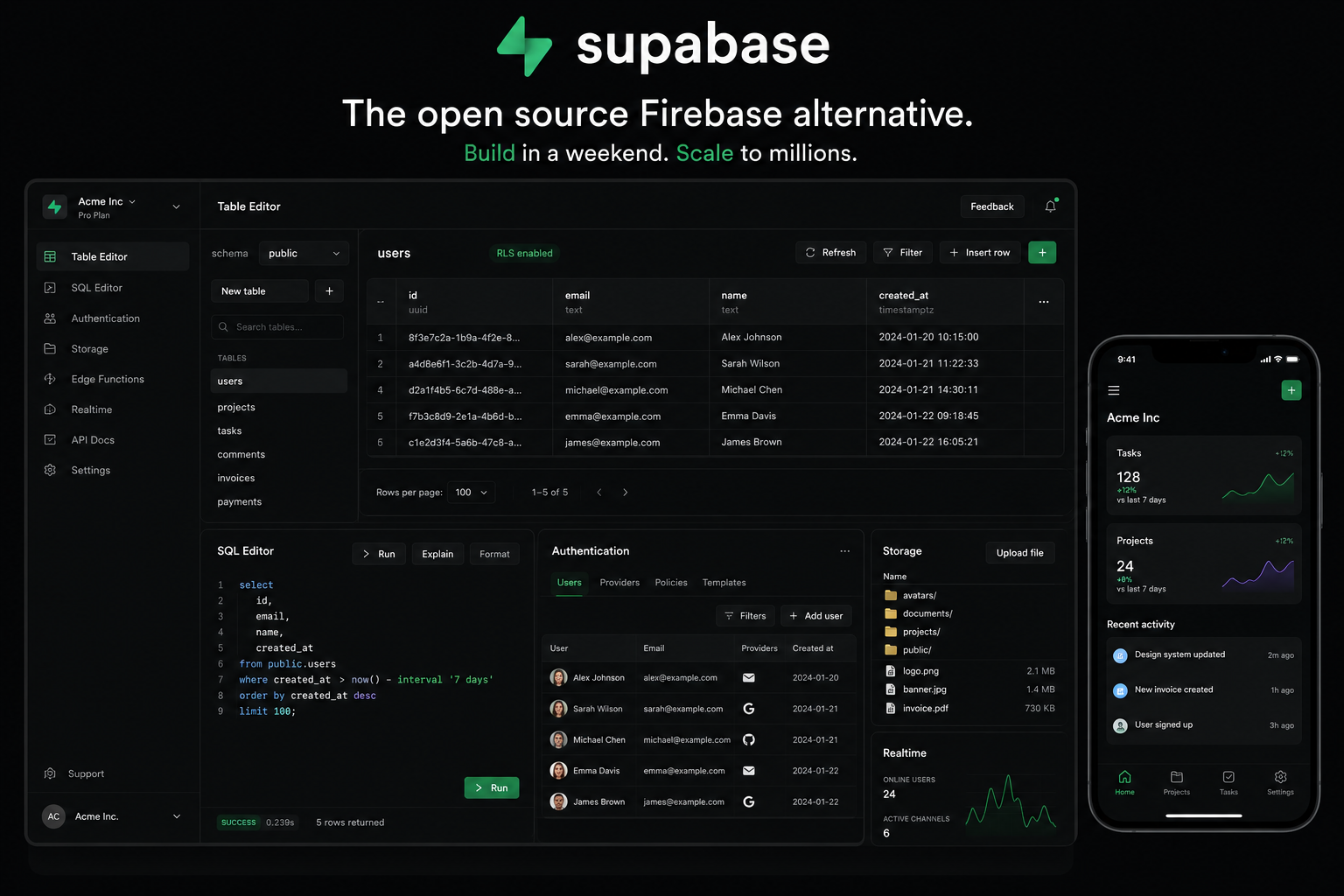
Supabase is an open-source backend platform built around PostgreSQL that helps developers create production-ready applications with database, auth, APIs, storage, edge functions, realtime, and vector capabilities.
Mature high-growth developer platform used by developers, startups, and enterprise teams to build production-ready applications on Postgres.
Business Context
Supabase gives builders backend speed while keeping Postgres control. The next challenge is helping AI-assisted and non-SQL builders make safe backend decisions.
The Vision
Product Users
Our users can build products quickly, but their work still depends on clear backend guidance when schema design, relationships, permissions, and production readiness collide.
Riya Patel
Frontend Developer
Profession: Frontend Developer
Occupation: Builds React and Next.js applications for early-stage SaaS products.
Experience: 4 years in frontend development and growing into full-stack product work.
Work Context: Can build the product interface quickly, but needs help translating product logic into database structure.
Behavior: Starts fast, then slows down when schema, relationships, and RLS decisions become required.
Goal: Create a safe backend foundation without relying on a backend engineer.
Pain Point: Needs schema, relationships, and RLS guidance inside the setup flow.
Karan Shah
Indie Hacker / Solo Founder
Profession: Indie Hacker / Solo Founder
Occupation: Launches SaaS products independently with AI-assisted coding and low-code tools.
Experience: 5 years building side projects and early-stage products.
Work Context: Moves fast from idea to MVP, often without a dedicated backend teammate.
Behavior: Uses templates and AI help, but worries the backend will break with real users.
Goal: Launch quickly while avoiding fragile backend decisions.
Pain Point: Needs backend setup that will not break when real users arrive.
Meera Iyer
AI-Assisted App Builder
Profession: AI-Assisted App Builder
Occupation: Uses AI tools and Supabase to build internal tools and lightweight apps.
Experience: 3 years in product operations and no-code/low-code app building.
Work Context: Translates internal workflow needs into app ideas with AI-generated frontend code.
Behavior: Describes product needs in natural language but struggles with database concepts.
Goal: Convert app logic into backend structure without learning SQL deeply.
Pain Point: Needs database structure and access control translated from natural language.
Daniel Chen
Startup CTO
Profession: Startup CTO
Occupation: Leads a small engineering team building B2B SaaS on Supabase.
Experience: 9 years in engineering and early-stage product architecture.
Work Context: Needs teams to ship fast without creating schema debt or security gaps.
Behavior: Encourages Supabase usage but reviews architecture and permissions carefully.
Goal: Accelerate team setup while protecting production quality.
Pain Point: Needs faster team setup without hidden schema and RLS risk.
Finalized User Persona
Riya Patel is the primary persona.
Riya understands product requirements, frontend workflows, APIs, and user experience, but does not have deep database design expertise. She represents builders who can create frontend applications quickly but need help setting up a reliable backend foundation.
Clear product intent
She knows what the app should do and how users should move through it.
Backend uncertainty
Tables, relationships, policies, and database constraints create friction.
High setup frequency
She hits these decisions each time she starts a new app or feature.
Security-sensitive decisions
RLS and permissions can create real risk if misunderstood.
Fast-moving workflow
She needs guidance without leaving the setup flow.
Solving for her scales
Helping Riya also supports founders, AI builders, and small teams.
User Journey
The current Supabase journey starts with product intent, but confidence drops when the user must convert that idea into safe schema, relationships, permissions, and RLS decisions.
Start with app idea
Action: Riya has a clear product flow and creates a Supabase project.
Thinking: The app idea is clear and momentum is high.
Pain Point: Backend structure is not yet visible.
Opportunity: Capture product entities and user roles from the idea.
01
02
Create schema
Action: She creates tables, columns, and data types.
Thinking: Small choices may affect the whole backend later.
Pain Point: Schema decisions feel intimidating without database expertise.
Opportunity: Generate a draft schema with rationale.
Define relationships
Action: She connects entities with primary keys and foreign keys.
Thinking: Relationships must match how the product behaves.
Pain Point: Relational modeling is hard to validate quickly.
Opportunity: Preview relationship logic and common mistakes.
03
04
Configure permissions
Action: She translates product rules into auth and RLS policies.
Thinking: Security cannot be guessed.
Pain Point: Permissions are powerful but easy to misconfigure.
Opportunity: Convert plain-language product rules into reviewable policies.
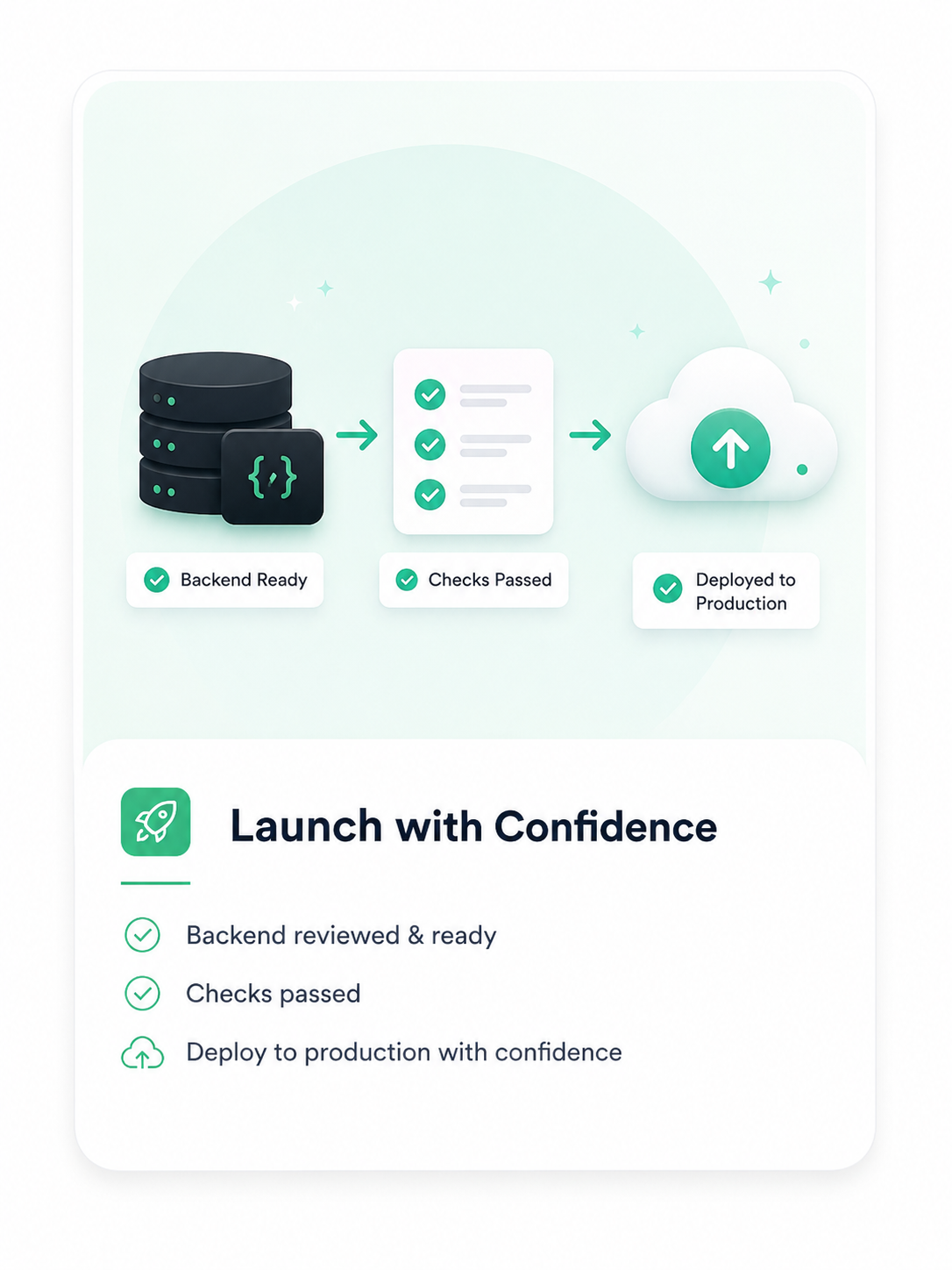
Launch with confidence
Action: She connects the frontend and prepares the backend for real users.
Thinking: She needs to know the foundation is safe enough.
Pain Point: Production readiness is unclear until errors appear.
Opportunity: Provide backend readiness checks before launch.
05
Understanding the Setup GapThe app idea was clear. The backend foundation was not.
01
Schema decisions feel intimidating
Users know the product experience but not the right tables, columns, and data types.
Creates
Slow setup and second-guessing.
02
Relationships are hard to design
Foreign keys and relational structure are difficult to model correctly.
Creates
Risk of broken data logic later.
03
Permissions are unclear
Product rules do not translate easily into access control and RLS.
Creates
Security anxiety before launch.
04
Production readiness is hard to judge
Users cannot tell whether the backend foundation will scale safely.
Creates
Low confidence in the build.
05
Debugging breaks momentum
Failed API requests and permission errors are hard to trace.
Creates
Trial-and-error instead of guided progress.
Prioritization of Pain Points
Each pain point was scored by user impact, frequency in the workflow, and product leverage. The goal was to identify the friction that matters most at the moment the product decision becomes real.
Pain Point
User Impact
Frequency
Product Leverage
Total
Schema decisions feel intimidatingBuilders struggle to design tables and fields safely.
5
5
5
15
Permissions are unclearProduct rules are hard to translate into RLS.
5
4
5
14
Relationships are hard to designRelational data modeling creates uncertainty.
4
4
5
13
Production readiness is hard to judgeUsers cannot tell whether setup is safe enough.
4
4
4
12
Debugging breaks momentumErrors are hard to connect back to setup decisions.
3
4
4
11
Prioritized Pain Point
Non-SQL builders hesitate because Supabase does not provide enough guided confidence when translating product intent into schema, relationships, permissions, and RLS policies.
Solution Ideas
Solutions are divided into OK, Best, and Moonshot categories. OK solutions are safe and expected. Best solutions balance feasibility and impact. Moonshot solutions can redefine the product workflow.
01
OK Solutions
1.
Guided Database Setup Checklist Guide users through common backend setup steps.
2.
Table Template Library Provide starter table templates for common app types.
3.
RLS Policy Examples Explain common policies in plain English.
4.
Relationship Explainer Show how tables should connect and why.
02
Best Solutions
1.
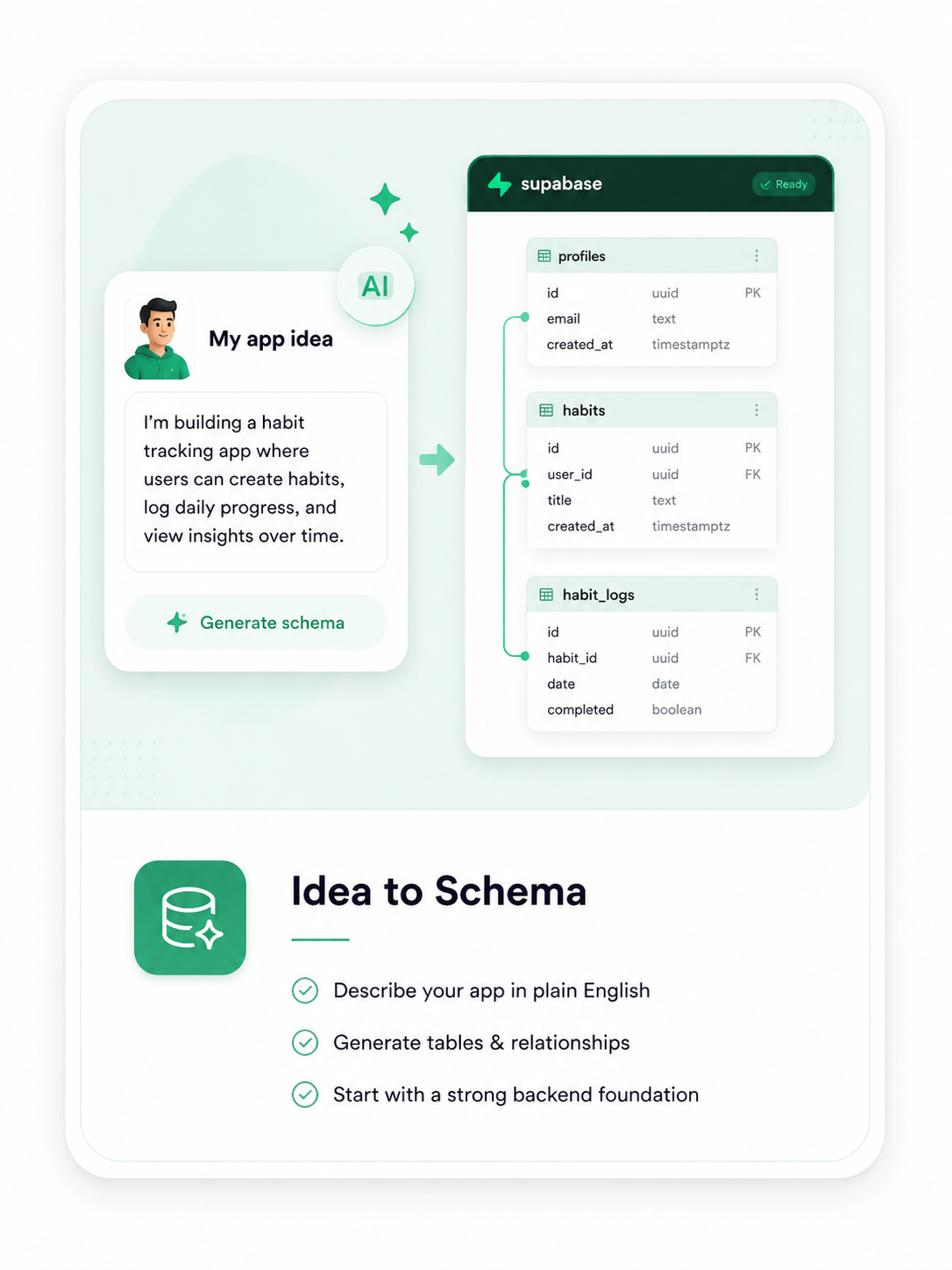
AI Schema Generator Generate schema from product idea and user roles.
2.
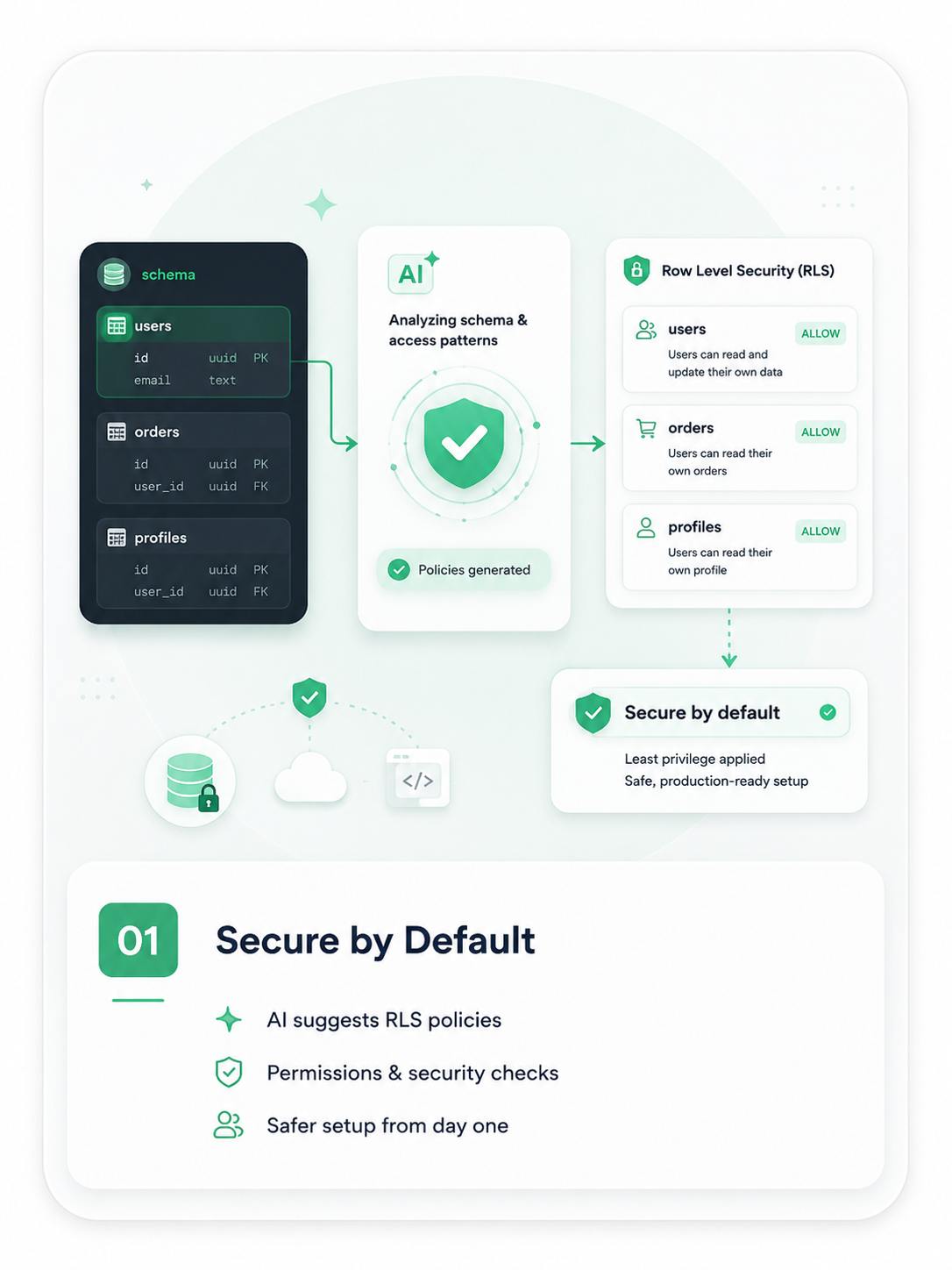
RLS Policy Builder Turn product rules into editable policy drafts.
3.
Backend Readiness Checker Check schema, relationships, and permissions before launch.
4.
Contextual Error Debugger Explain API and RLS errors in setup context.
03
Moonshot Solutions
1.
Supabase AI Backend Architect Generate and explain the backend foundation from product intent.
2.
Interactive Schema Simulation Let users test flows before creating production tables.
3.
Self-Healing Backend Setup Detect setup gaps and recommend safe fixes.
4.
App-to-Backend Blueprint Generator Convert app screens and flows into backend blueprint.
Prioritize Moonshot Ideas
Framework used: Weighted Decision Matrix. Moonshot ideas have high uncertainty, so they are evaluated on strategic value, user impact, feasibility, risk control, and business value.
Moonshot Solution
User Impact
Strategic Fit
Feasibility
Risk Control
Business Value
Weighted Score
Supabase AI Backend ArchitectGenerate and explain schema, relationships, and policies from product intent.
5
5
4
4
5
4.65 / 5
Interactive Schema SimulationTest app flows and data rules before implementation.
5
4
3
4
4
4.20 / 5
Self-Healing Backend SetupDetect setup mistakes and suggest safer fixes.
4
5
3
3
5
4.10 / 5
App-to-Backend Blueprint GeneratorTurn app screens and flows into backend architecture.
4
4
3
3
4
3.85 / 5
Finalized Idea
Supabase AI Backend Architect
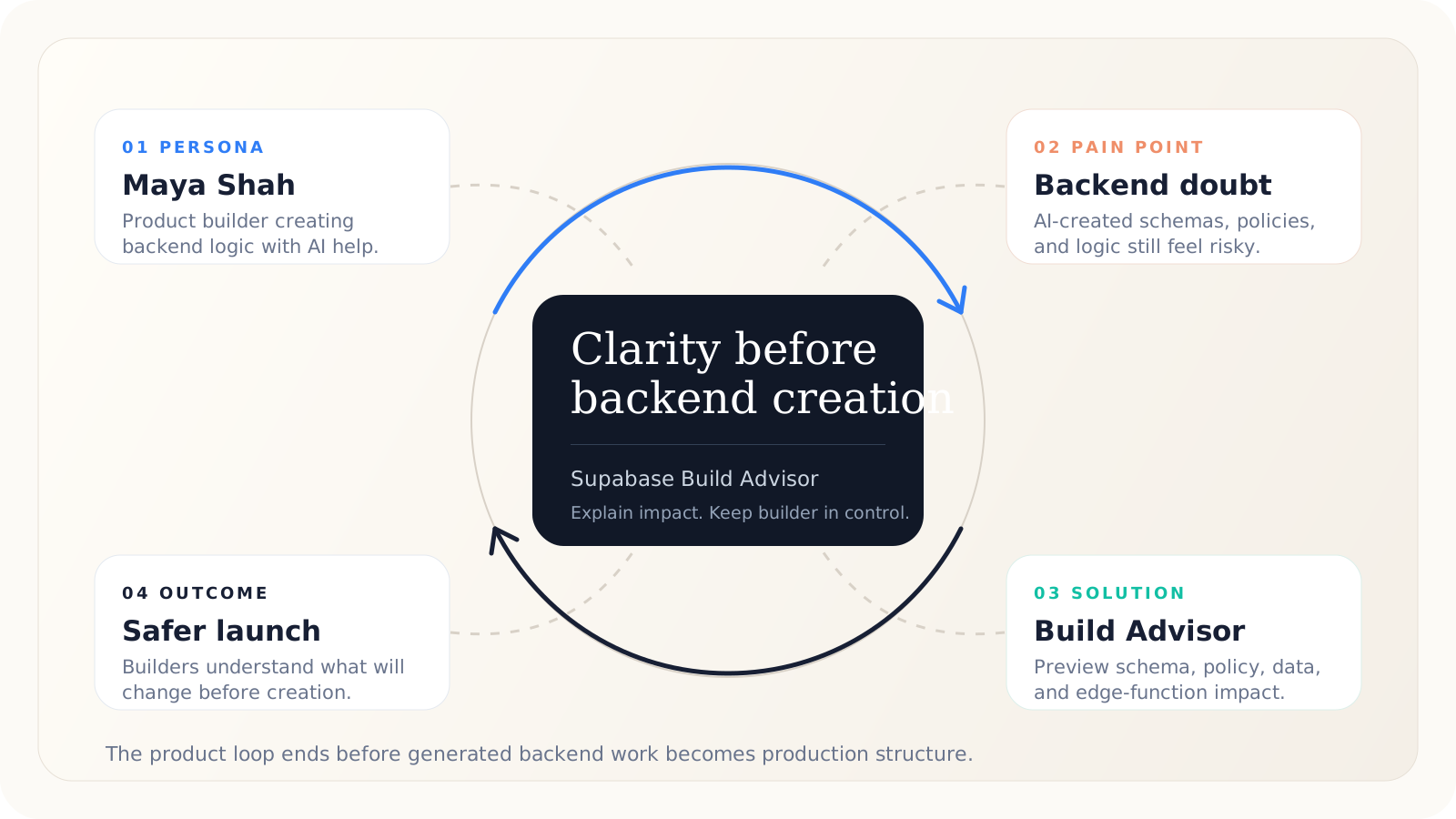
Supabase AI Backend Architect directly solves the highest-priority gap: builders need clear guidance before backend setup decisions become production structure.
Solution Direction
Instead of only offering backend primitives, Supabase would help builders evaluate and generate the backend foundation through structured schema, relationship, permission, and RLS guidance.
User Flow: AI Backend Architect Journey
Start from backend workspace
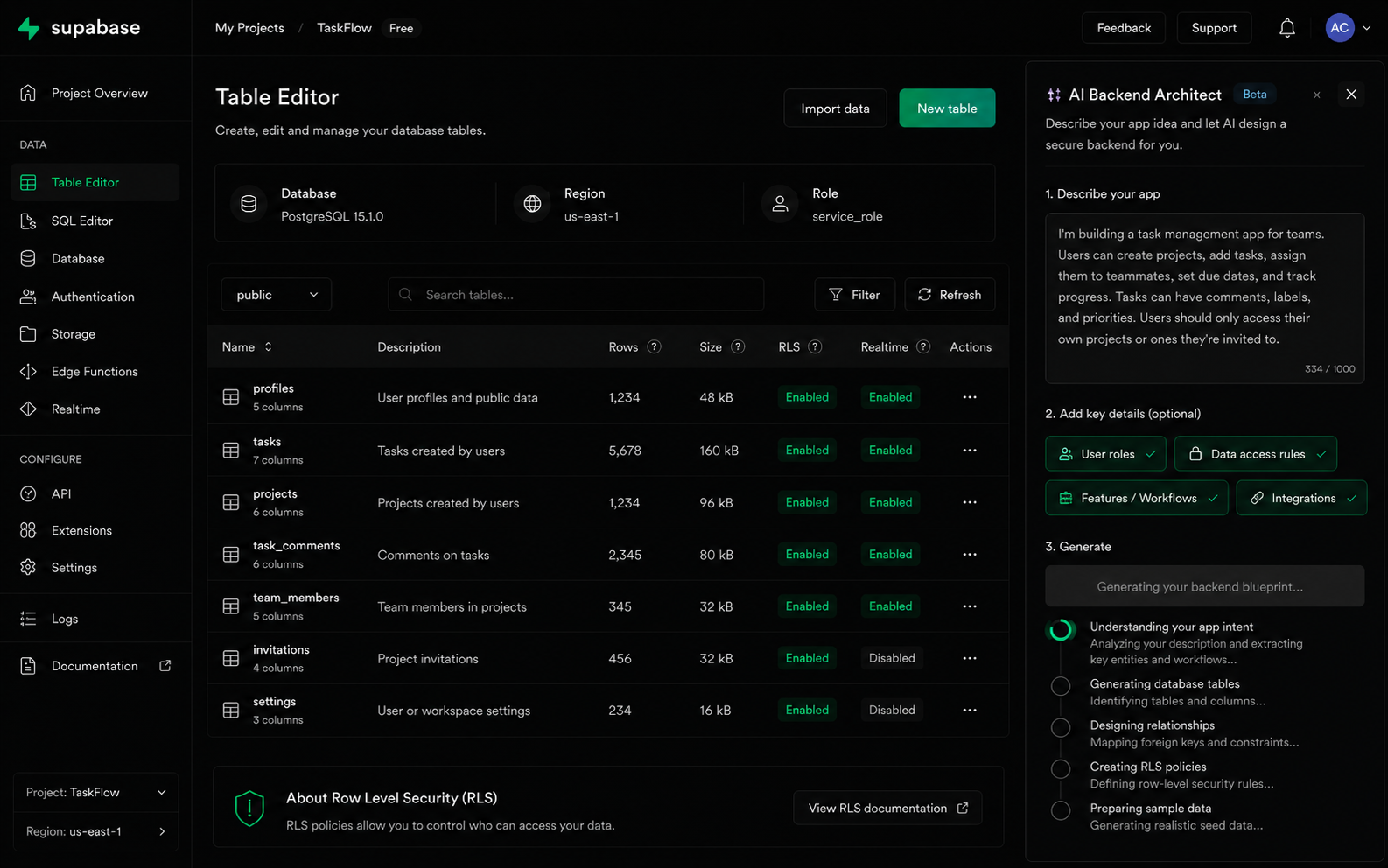
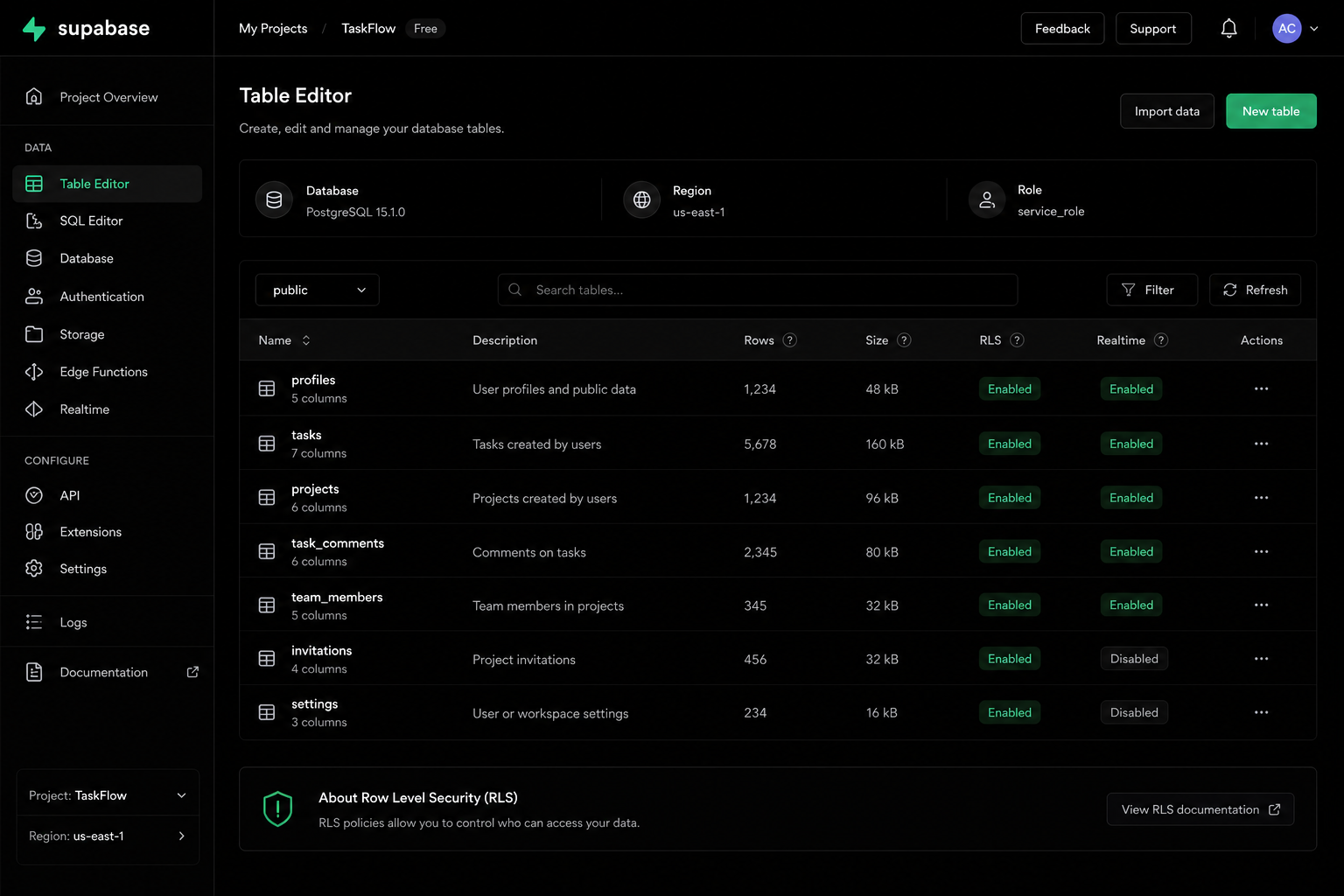
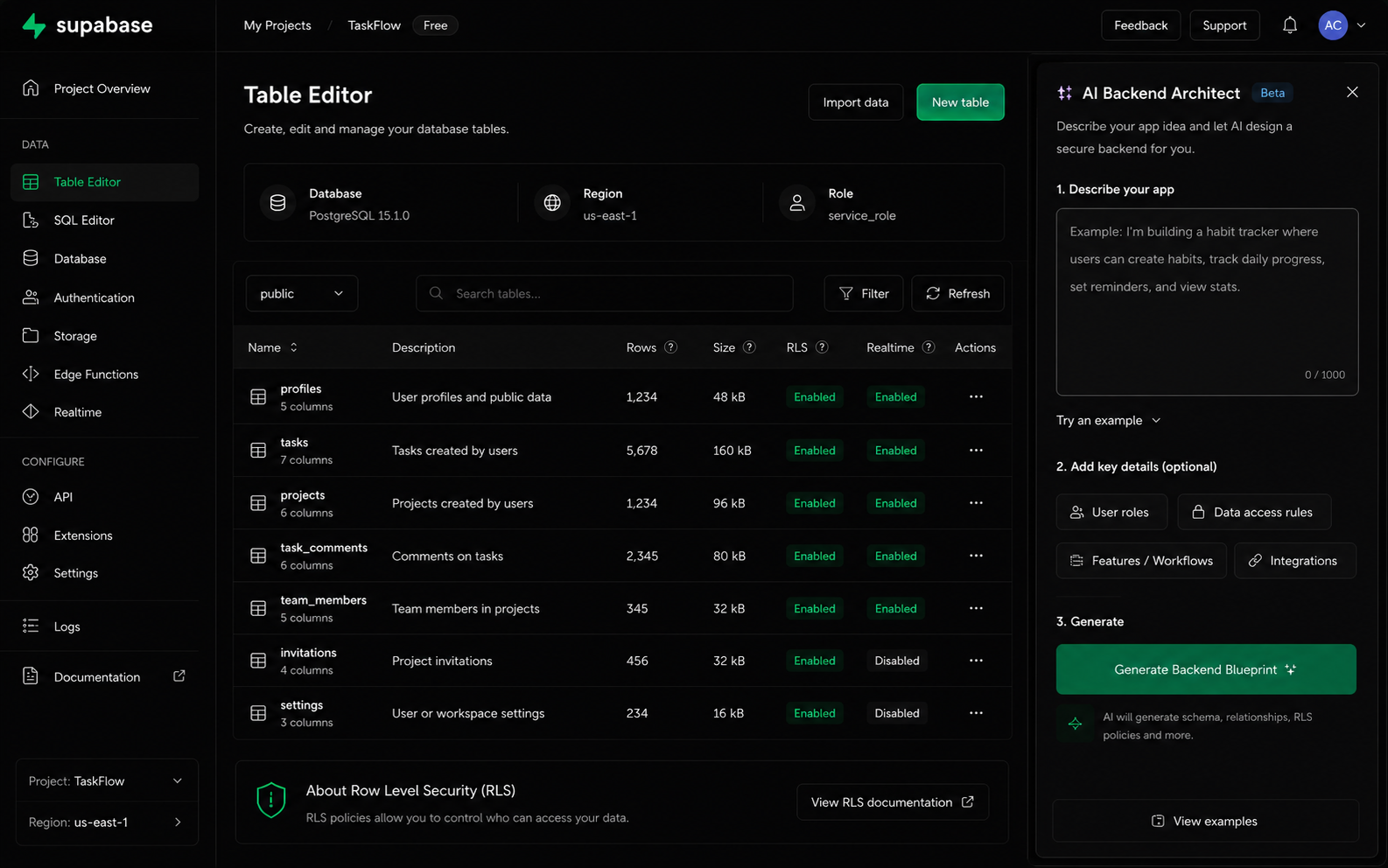
The builder sees tables and the AI Backend Architect entry point inside the existing Supabase workflow.
Open guided setup
The user begins a guided backend architecture session without leaving the table editor.
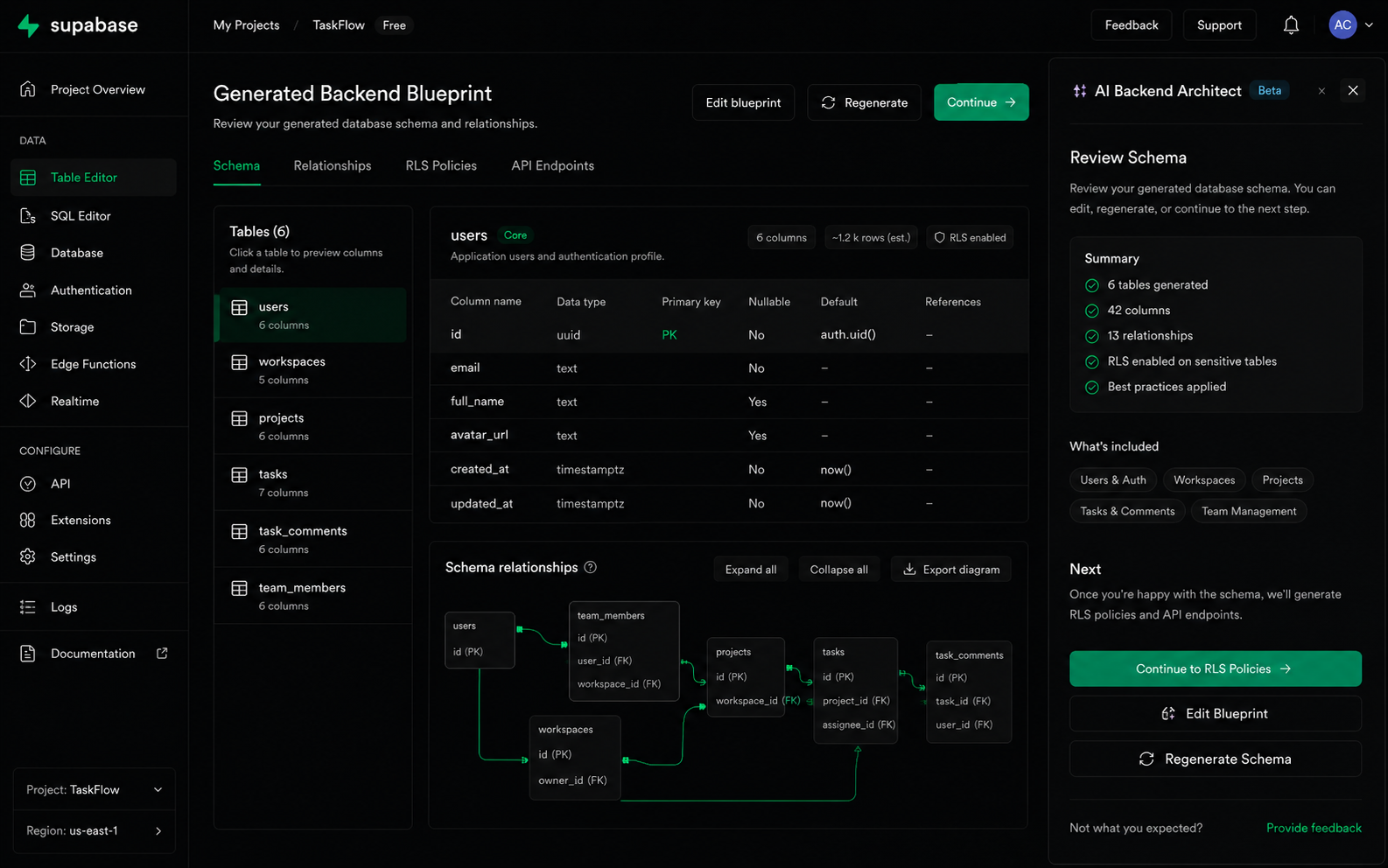
Generate backend blueprint
Supabase converts product intent into tables, relationships, and data structure.
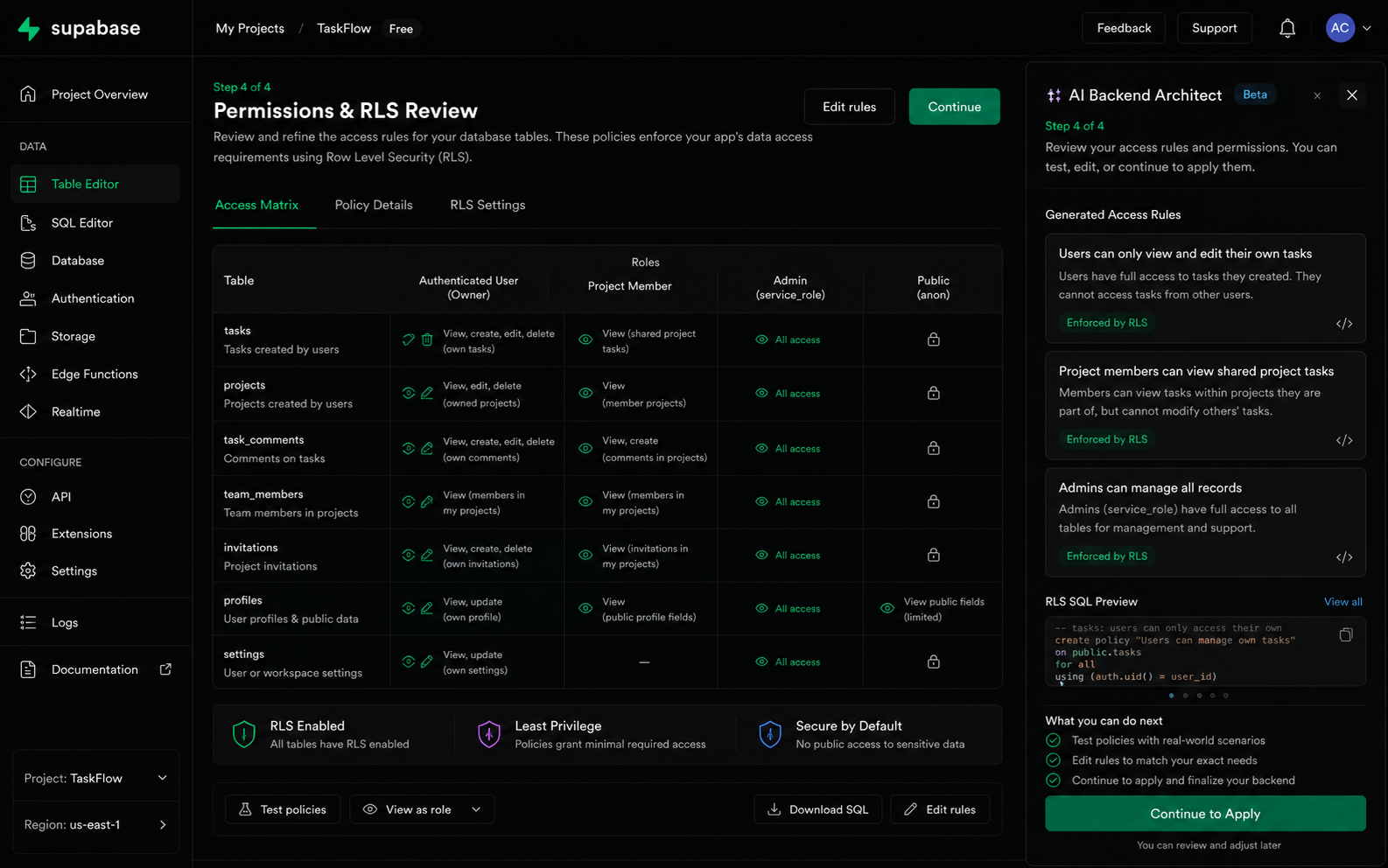
Review permissions and RLS
Access rules are made visible before the backend becomes production structure.
Refine recommendations
The builder can edit, regenerate, or request safer backend recommendations.
Simulate and validate
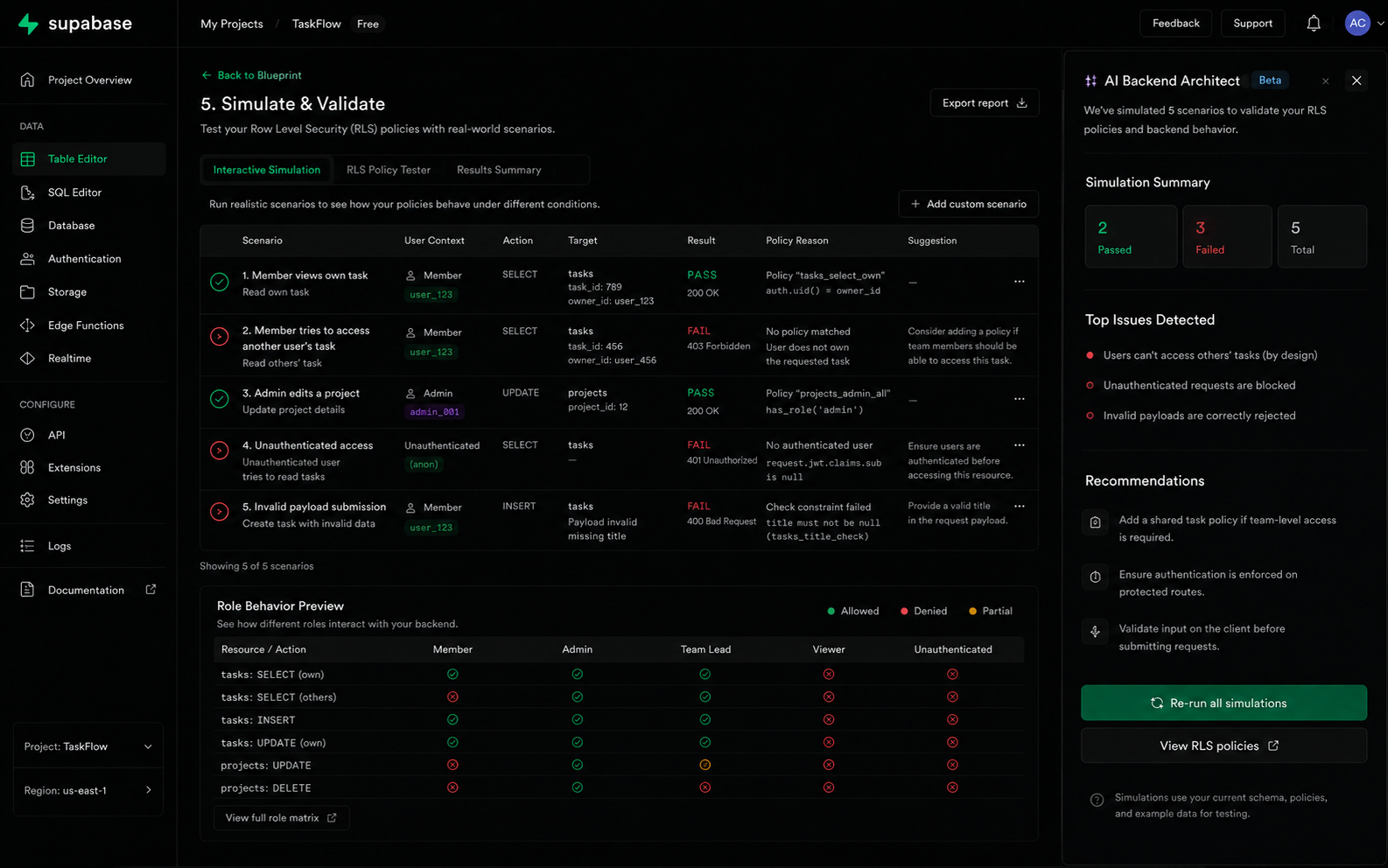
App flows and data rules are tested before implementation goes live.
Create with confidence
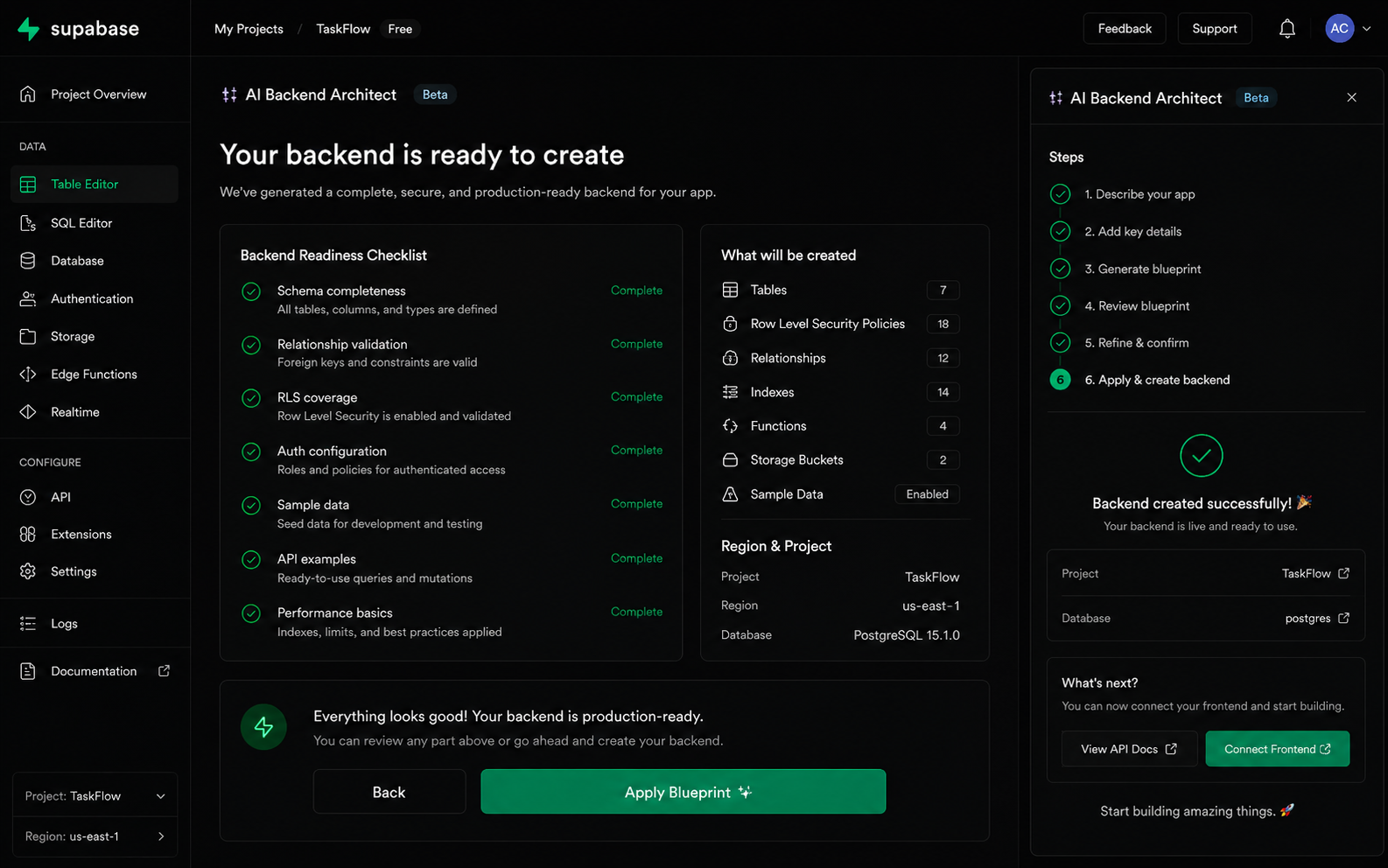
The final backend setup is ready to apply with schema, policies, and checks visible.
The solution turns Supabase from a powerful backend workspace into a guided backend architecture partner.
01
Translate intent
Convert app idea, entities, user roles, and product rules into backend structure.
02
Surface risk
Flag missing relationships, unsafe permissions, and RLS gaps before launch.
03
Recommend setup
Suggest schema, policies, and readiness checks while keeping the builder in control.
Input layer
Product intent enters the system
App idea, user roles, entities, screens, actions, and access rules.
Schema layer
Backend structure is drafted
Tables, columns, data types, keys, and relationships are proposed.
Security layer
Policies become understandable
Permissions and RLS are translated into clear, reviewable rules.
Decision layer
Builder stays in control
The user can accept, edit, simulate, or ask for explanations.
Outcome
Backend starts with confidence
The product reduces schema anxiety and setup rework before launch.
MVP Scope
The first version focuses tightly on the decision moment where users currently lose confidence.
Workflow shift
Move from manual setup and second-guessing to guided evaluation before the user commits to a product decision.
Product boundary
The MVP does not replace expert judgment. It adds a lightweight decision layer inside the existing Supabase workflow.
MVP objective
Help builders turn product intent into a reviewed backend blueprint with schema, relationships, RLS, and simulation checks before applying changes.
In Scope
Purpose
AI Backend Architect Entry Point
Starts from the existing Supabase project/table editor and opens a guided architecture assistant.
Product Intent Intake
Captures app idea, entities, roles, actions, and access rules.
Generated Backend Blueprint
Drafts tables, fields, relationships, and database structure.
Permissions and RLS Review
Explains access rules, risky defaults, and policy gaps in plain language.
Simulation and Validation
Tests common product flows against schema and policies before apply.
Apply Reviewed Backend
Lets builders apply, edit, regenerate, or export the proposed setup.
Out of Scope
Autonomous production migration
Replacing database expertise completely
Guaranteed secure schema claims
Enterprise governance dashboard
Custom model training per project
Automatic destructive database changes
Success Metrics
These metrics focus on whether the MVP improves decision confidence without adding unnecessary workflow friction.
North Star Metric
Backend Confidence Rate
Percentage of generated backend blueprints that are reviewed, adjusted, and applied after schema, relationship, and RLS guidance is shown.
Activation Metrics
Risks, Guardrails & Constraints
Supabase should guide decisions without pretending that automation removes user responsibility.
Product principle
Increase backend confidence without hiding the complexity of schema, access rules, or production responsibility.
Schema Accuracy Risk
Structure
AI may generate a schema that looks plausible but misses product edge cases.
Guardrails
Show assumptions, editable entities, relationship reasoning, and unresolved questions.