Fintech · Digital Payments · Payment Gateway · Merchant Finance
Product Stage
Mature large-scale fintech platform used by startups, small businesses, marketplaces, D2C brands, and enterprises.
Business Context
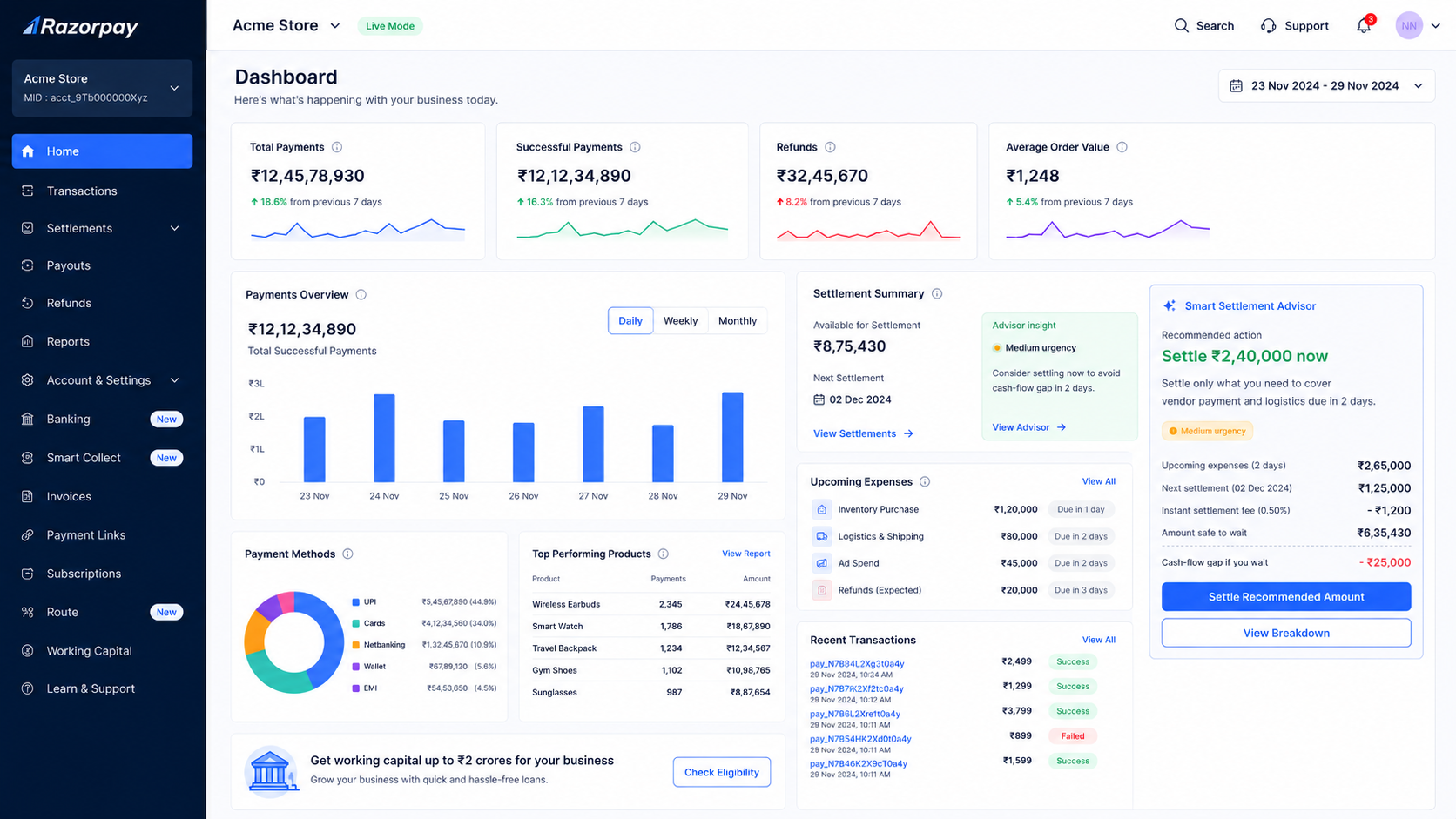
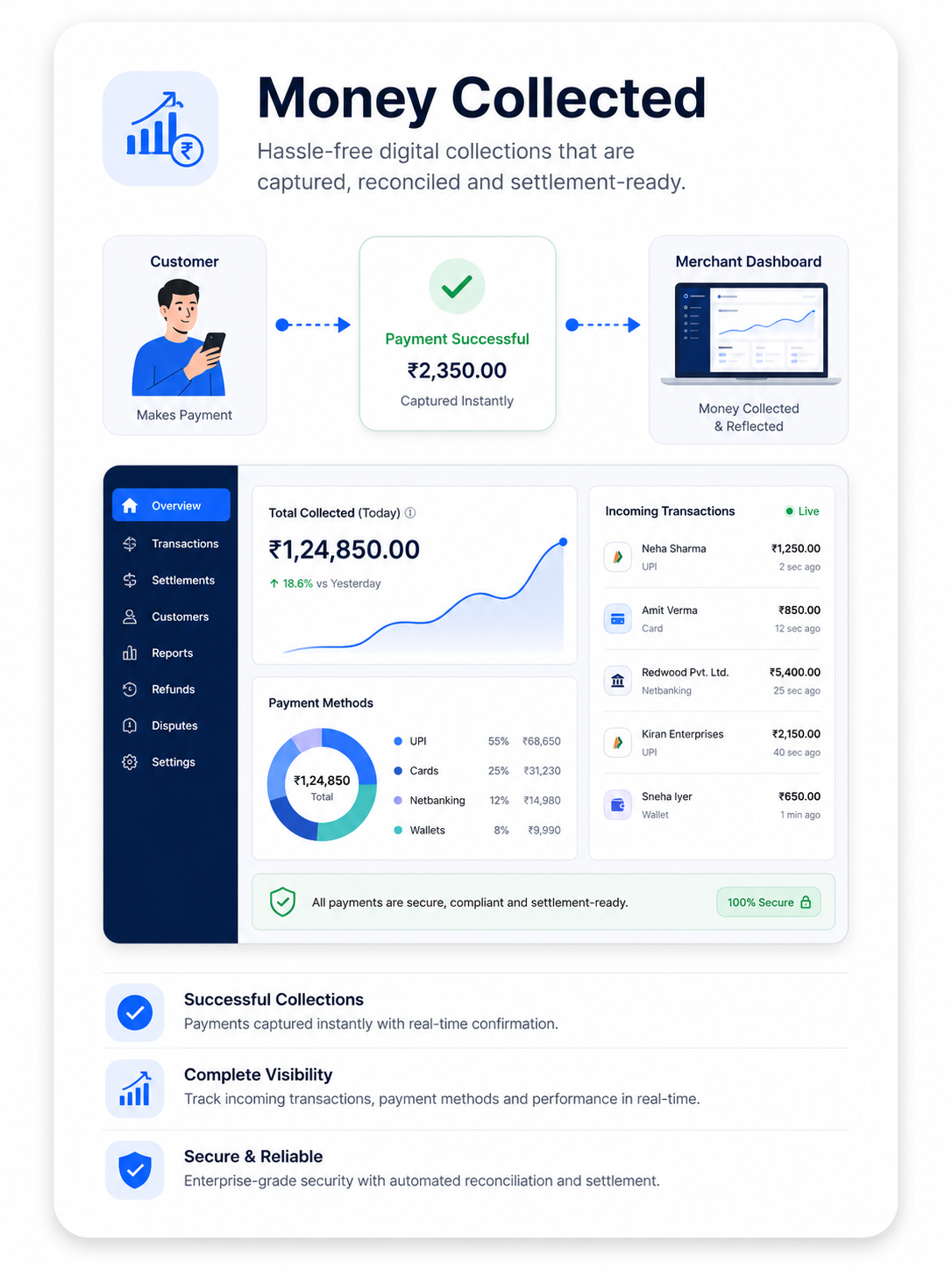
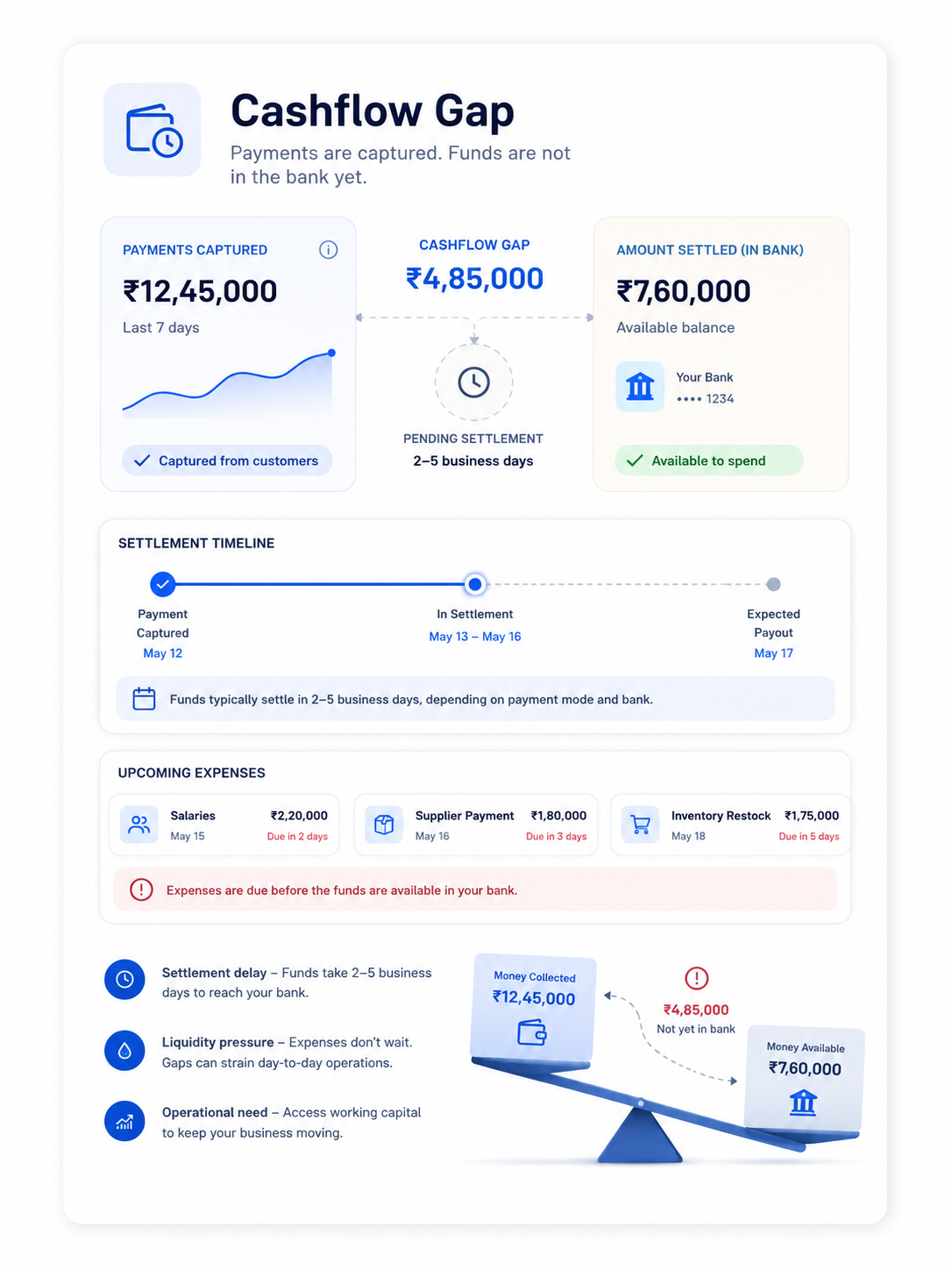
After payment capture, merchants may still face a cash-flow gap because settlements do not always reach the bank account immediately.
The Vision
Product Users
Our users understand their business operations, but settlement decisions still depend on clear liquidity guidance when available balance, upcoming expenses, fees, and urgency collide.
Vikram Malhotra
D2C Brand Owner
Profession: D2C Brand Owner
Occupation: Runs an online consumer brand and manages inventory, suppliers, e-commerce, and payment operations.
Experience: 6 years building and operating a growing consumer brand.
Work Context: Handles tight working-capital cycles across inventory, ads, logistics, refunds, and vendors.
Behavior: Checks Razorpay settlement balance often but decides instant settlement based on pressure.
Goal: Keep operations funded without paying unnecessary settlement fees.
Pain Point: Needs healthy cash flow without guessing when to settle instantly.
Aisha Khan
Finance Ops Manager
Profession: Finance Ops Manager
Occupation: Manages reconciliation, settlements, vendor payouts, refunds, and cash-flow planning.
Experience: 7 years in finance operations and payment reconciliation.
Work Context: Tracks incoming funds, expenses, settlement timing, and payout obligations.
Behavior: Works with spreadsheets and dashboards to understand cash availability.
Goal: Turn settlement data into action quickly.
Pain Point: Needs settlement data translated into a clear action.
Ramesh Gupta
Small Retail Merchant
Profession: Small Retail Merchant
Occupation: Runs a local retail and online hybrid store with limited dashboard experience.
Experience: 12 years running retail operations.
Work Context: Depends on daily cash availability for stock, staff, and logistics.
Behavior: Looks for simple signals more than detailed financial analysis.
Goal: Access money at the right time without confusion.
Pain Point: Needs timely access to money without confusion about settlement status.
Neha Desai
Marketplace Ops Lead
Profession: Marketplace Ops Lead
Occupation: Manages seller payouts, refunds, logistics, and payment operations for a marketplace.
Experience: 8 years in marketplace and operations roles.
Work Context: Balances liquidity, obligations, seller trust, refunds, and settlement fees.
Behavior: Needs predictable decisions across repeated settlement cycles.
Goal: Balance payout reliability with cost control.
Pain Point: Needs settlement intelligence to balance liquidity, fees, and obligations.
Finalized User Persona
Vikram Malhotra is the primary persona.
Vikram sits at the point where payment success and merchant liquidity meet. Sales may be coming in, but inventory, suppliers, logistics, refunds, and ads depend on when money actually reaches the bank.
Frequent settlement decisions
He faces the wait, settle now, or partial settle decision repeatedly.
Owns cash-flow pressure
Business continuity depends on whether money reaches the bank in time.
Cost-sensitive tradeoff
Instant settlement helps liquidity but adds fees.
Operational consequences
Bad decisions affect inventory, vendors, salaries, ads, and refunds.
Needs action clarity
Raw numbers are not enough during cash-flow pressure.
Solving for him scales
Helping Vikram also supports finance ops, retailers, and marketplaces.
User Journey
The current Razorpay journey starts with successful payment collection, but confidence drops when the merchant has to decide whether waiting, instant settlement, or partial settlement is the right cash-flow move.
Payment is captured
Action: Vikram sees sales and settlement balance building up.
Thinking: Money has been collected, but may not be usable yet.
Pain Point: Payment success does not equal bank availability.
Opportunity: Separate collected, incoming, available, and urgent money clearly.
01
02
Check cash needs
Action: He reviews upcoming inventory, vendor, logistics, ads, and refund obligations.
Thinking: He needs to know whether cash will arrive in time.
Pain Point: Expenses often sit outside Razorpay.
Opportunity: Bring near-term obligations into the settlement decision.
Evaluate settlement options
Action: He considers waiting, settling instantly, or settling partially.
Thinking: He wants liquidity but does not want unnecessary fees.
Pain Point: The cost-benefit tradeoff is not clearly recommended.
Opportunity: Compare options with fee, timing, and risk.
03
04
Make a pressured decision
Action: He chooses a settlement action under time pressure.
Thinking: The decision feels like a guess.
Pain Point: A wrong choice can create either cost or cash shortage.
Opportunity: Recommend the lowest-cost action that covers urgency.
Repeat the cycle
Action: The same settlement decision returns next week.
Thinking: He wants the system to learn the business rhythm.
Opportunity: Turn settlement behavior into smarter recurring guidance.
05
Understanding the Liquidity GapPayment success did not always mean usable money in the bank.
01
Settlement decisions rely on guesswork
Merchants do not know whether to wait, settle instantly, or partially settle.
Creates
Cost anxiety and hesitation.
02
Cash-flow gaps are hard to identify
Available, incoming, and urgent money are not converted into a decision signal.
Creates
Unclear operating runway.
03
Expenses are disconnected
Upcoming obligations often live outside the payment dashboard.
Creates
Incomplete settlement judgment.
04
Fees create anxiety
Instant settlement has a cost, but the value of speed is hard to compare.
Creates
Avoidable fees or missed liquidity.
05
The same decision repeats
Merchants repeatedly make similar settlement choices without learning support.
Creates
Ongoing operational stress.
Prioritization of Pain Points
Each pain point was scored by user impact, frequency in the workflow, and product leverage. The goal was to identify the friction that matters most at the moment the product decision becomes real.
Pain Point
User Impact
Frequency
Product Leverage
Total
Settlement decisions rely on guessworkMerchants do not know which settlement action is right.
5
5
5
15
Cash-flow gaps are hard to identifyAvailable and incoming money are not decision-oriented.
5
5
4
14
Expenses are disconnectedUpcoming obligations are outside the settlement view.
4
4
5
13
Fees create anxietyThe value of instant settlement is hard to compare.
4
4
4
12
The same decision repeatsRecurring settlement choices do not get smarter.
4
3
4
11
Prioritized Pain Point
Merchants are unsure whether to wait, settle instantly, or partially settle because Razorpay does not convert settlement balance, upcoming expenses, urgency, and settlement fee into a clear cash-flow recommendation.
Solution Ideas
Solutions are divided into OK, Best, and Moonshot categories. OK solutions are safe and expected. Best solutions balance feasibility and impact. Moonshot solutions can redefine the product workflow.
01
OK Solutions
1.
Settlement Timeline Card Show when funds will reach the bank.
2.
Instant Settlement Fee Calculator Show the exact cost of settling now.
3.
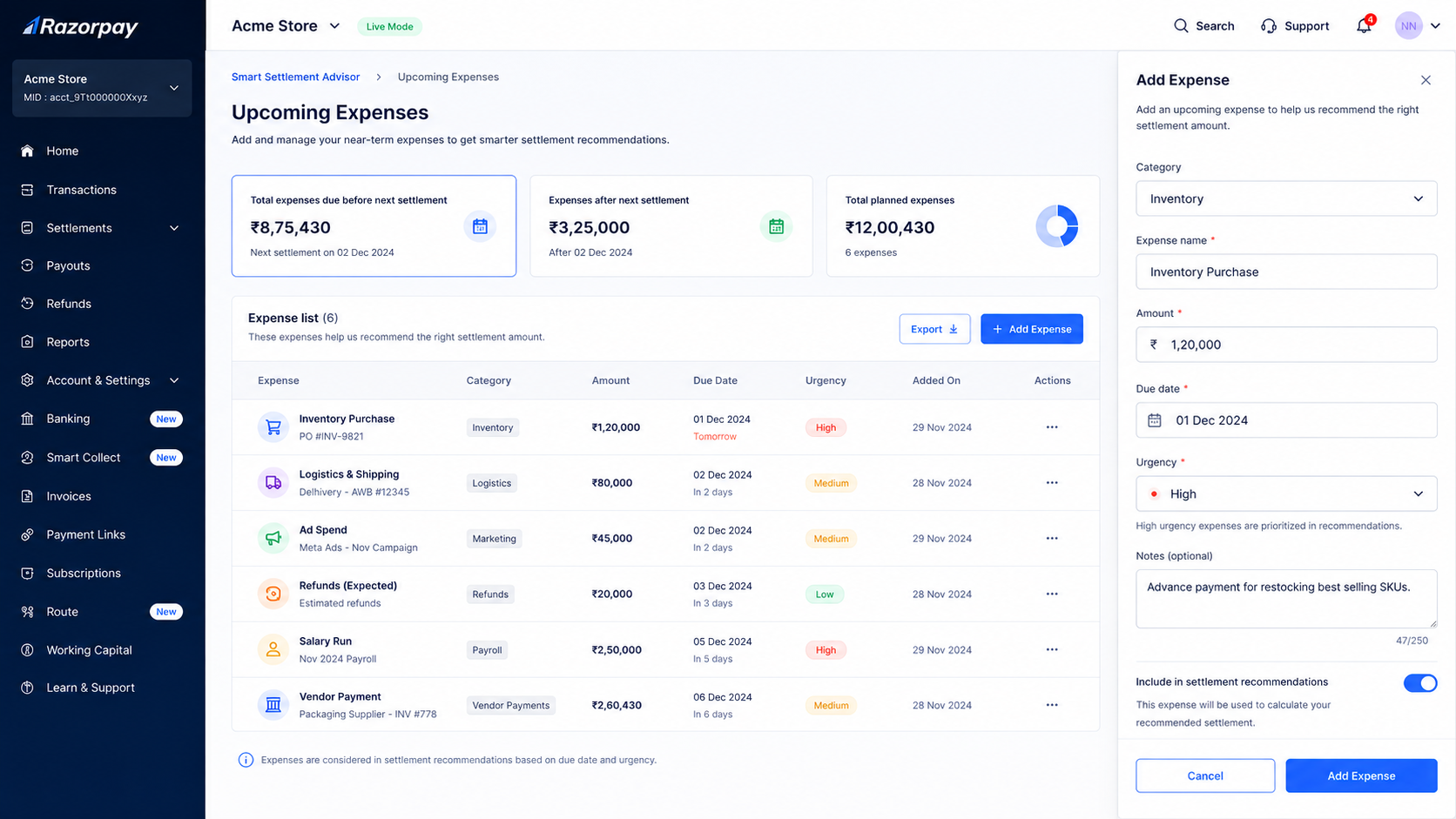
Upcoming Expense Input Let merchants add near-term obligations.
4.
Settlement Reminder Alerts Notify merchants before key cash-flow moments.
02
Best Solutions
1.
Cashflow Gap Detector Detect when bank balance may fall short before settlement arrives.
Partial Settlement Optimizer Suggest the lowest-cost amount that covers urgency.
4.
Cashflow Forecast Dashboard Project near-term liquidity using settlements and expenses.
03
Moonshot Solutions
1.
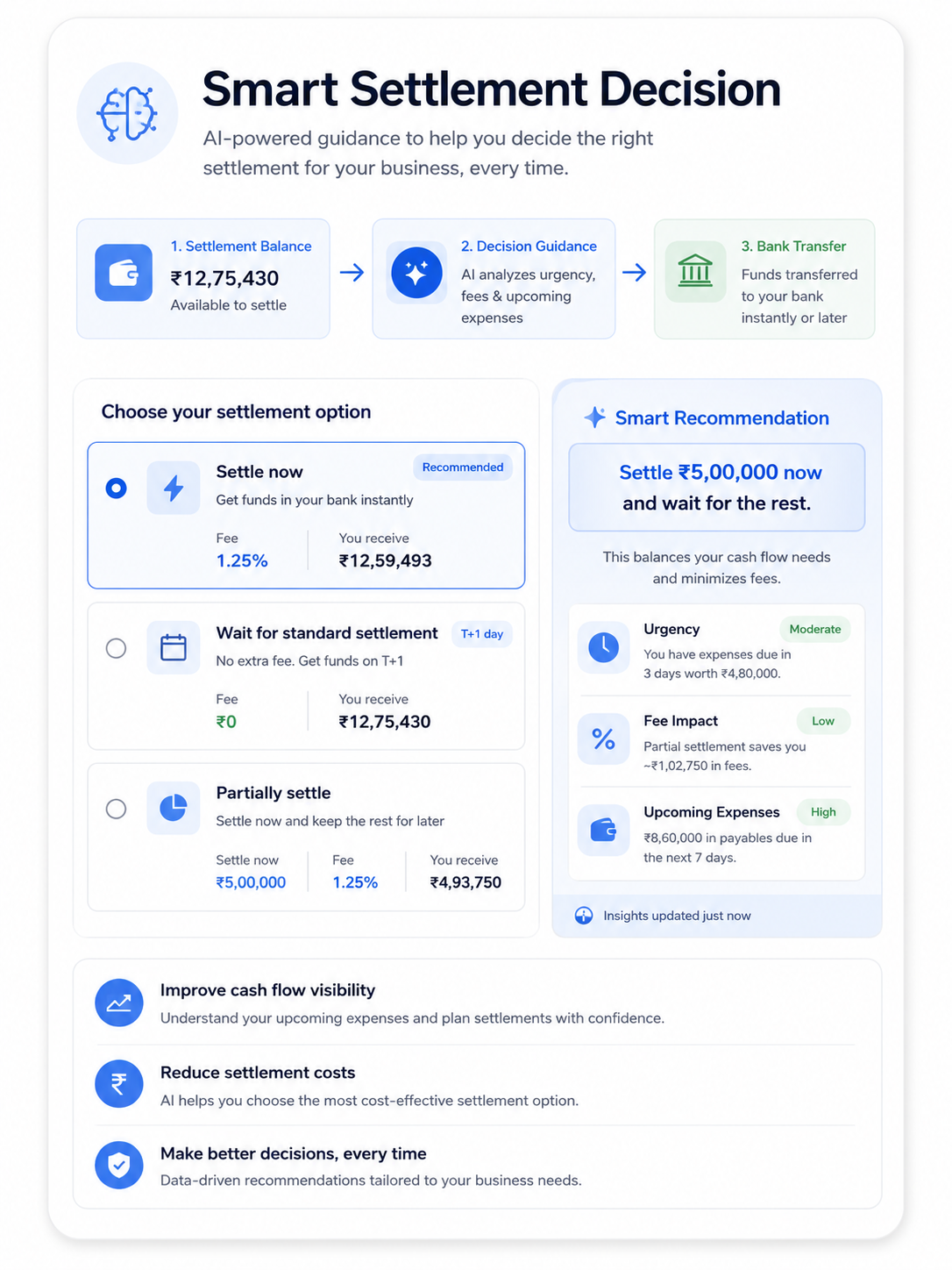
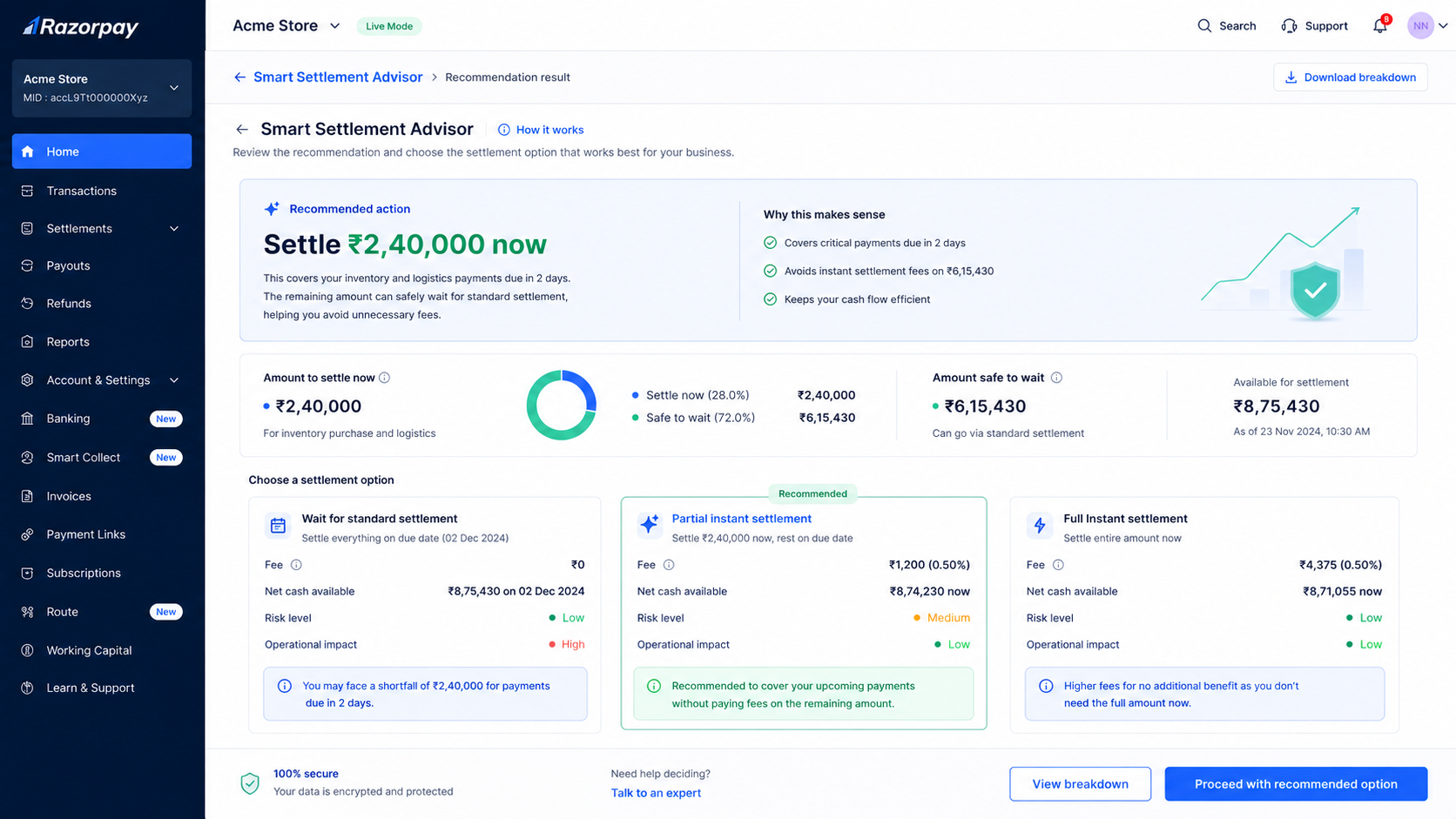
Razorpay Smart Settlement Advisor Guide merchants to wait, instantly settle, or partially settle.
2.
Autonomous Cashflow Planner Plan settlement, payouts, and liquidity moves automatically.
3.
Merchant Liquidity Score Score short-term liquidity health and risk.
4.
Embedded Working Capital Trigger Recommend credit when settlement is not enough.
Prioritize Moonshot Ideas
Framework used: Weighted Decision Matrix. Moonshot ideas have high uncertainty, so they are evaluated on strategic value, user impact, feasibility, risk control, and business value.
Moonshot Solution
User Impact
Strategic Fit
Feasibility
Risk Control
Business Value
Weighted Score
Razorpay Smart Settlement AdvisorRecommend wait, instant settlement, or partial settlement.
5
5
4
5
5
4.80 / 5
Autonomous Cashflow PlannerPlan settlement, payouts, and liquidity moves automatically.
5
5
3
4
5
4.45 / 5
Merchant Liquidity ScoreScore short-term liquidity health and risk.
4
5
4
4
4
4.35 / 5
Embedded Working Capital TriggerRecommend working capital when settlement is not enough.
4
4
3
3
5
3.95 / 5
Finalized Idea
Razorpay Smart Settlement Advisor
Razorpay Smart Settlement Advisor directly solves the decision gap by recommending whether to wait, settle instantly, or partially settle based on urgency and settlement cost.
Solution Direction
Instead of showing settlement balance as a raw number, Razorpay would help merchants evaluate that balance against expenses, urgency, fee, and timing through structured cash-flow guidance.
User Flow: Smart Settlement Advisor Journey
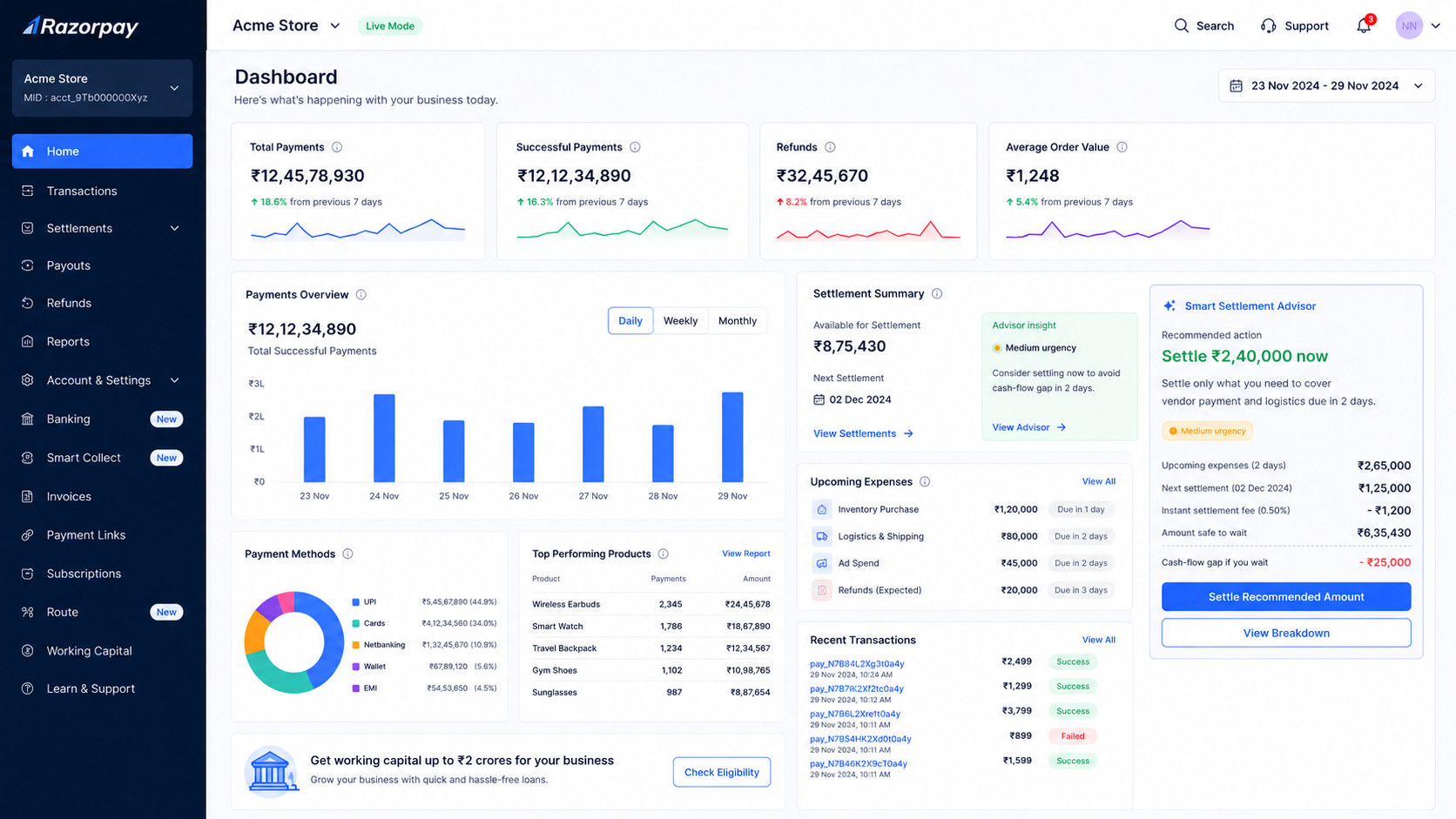
Start from settlement dashboard
The merchant sees cash position, settlements, expenses, and the settlement advisor entry point.
Map upcoming expenses
Razorpay connects settlement choices to upcoming payouts, bills, payroll, and operating needs.
Recommend settlement option
The advisor recommends how much to settle now and why that action fits the cash need.
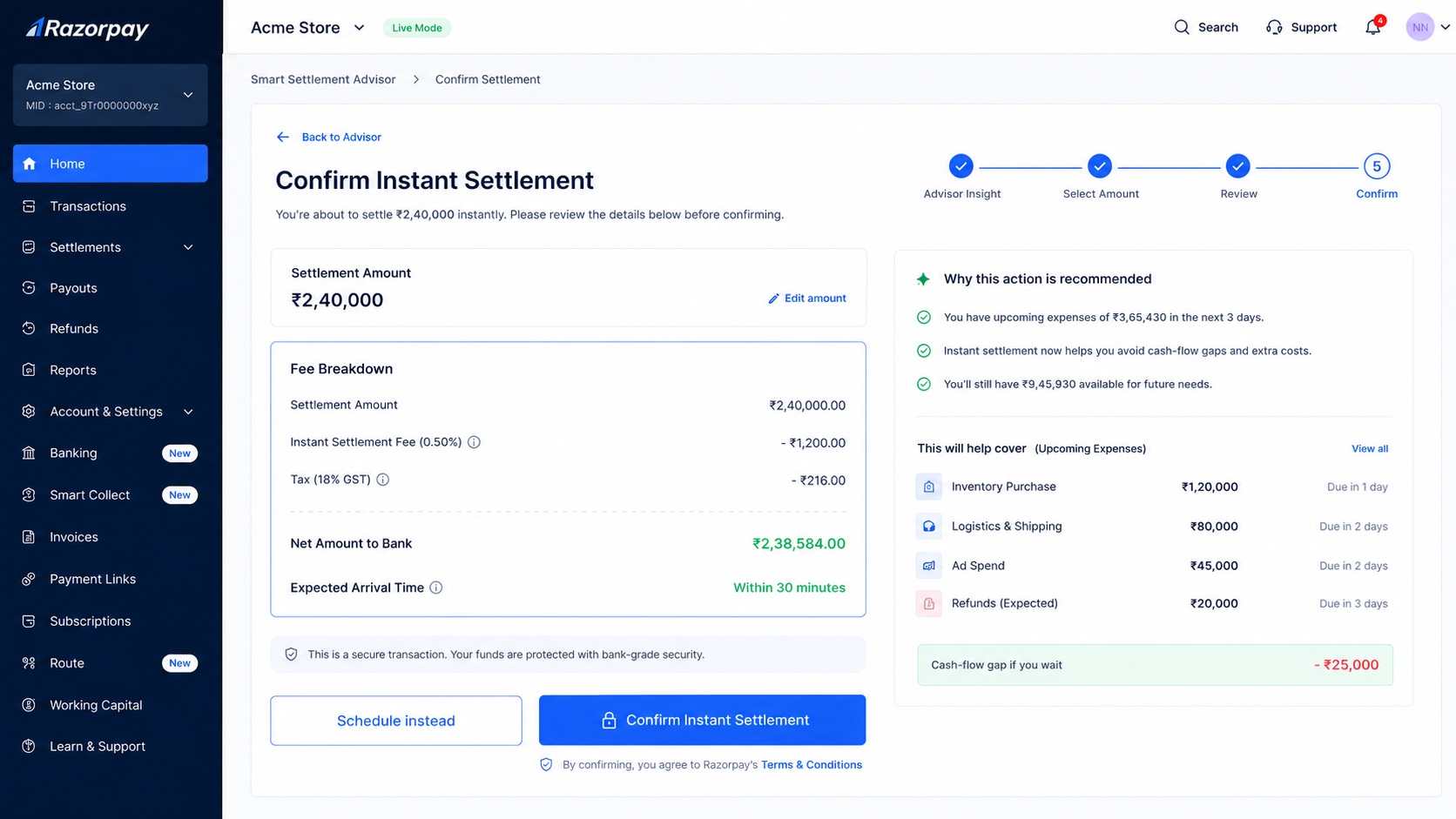
Confirm the decision
The merchant reviews fee, timing, and cash-flow impact before confirming settlement.
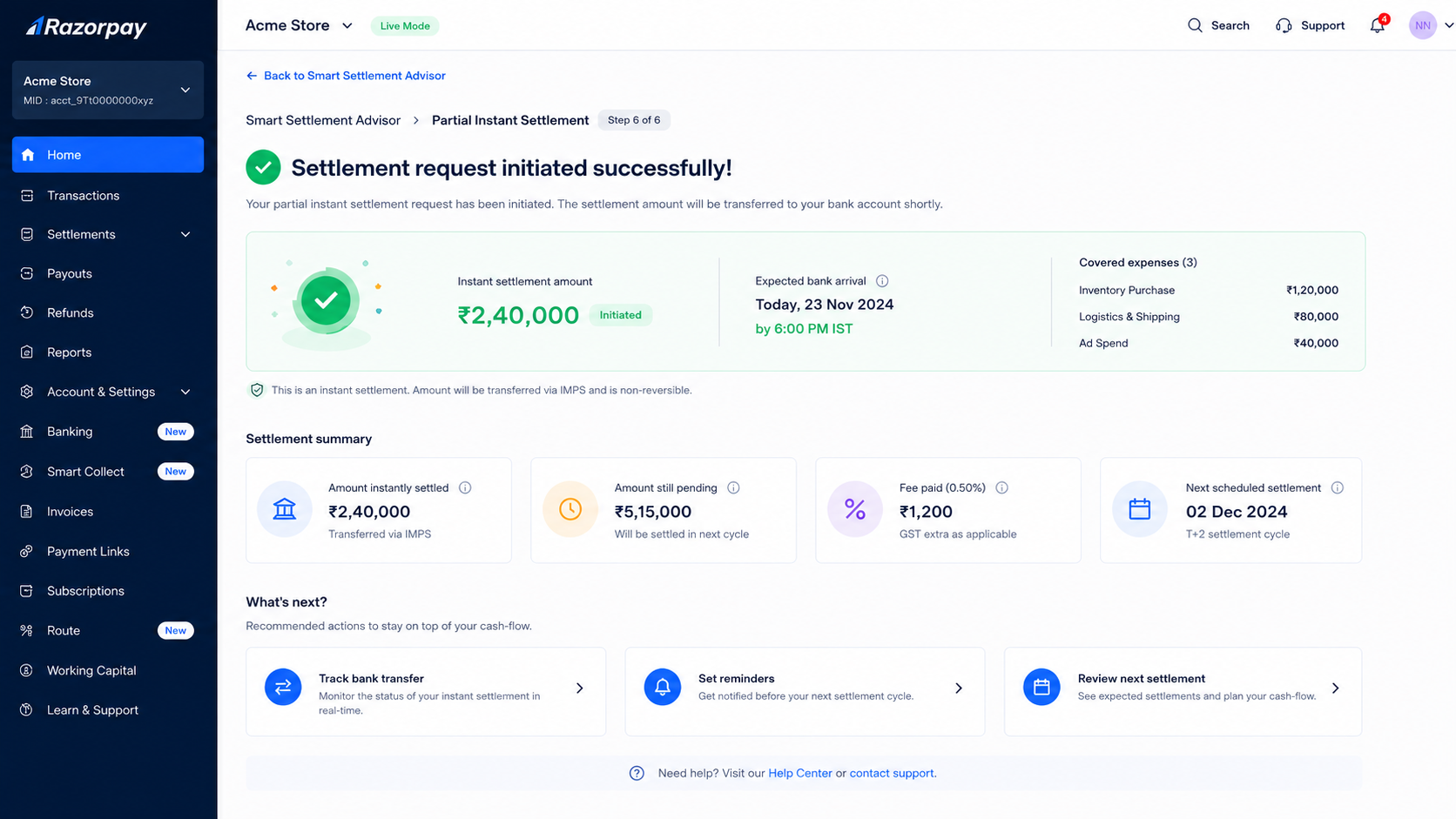
Track request status
The product confirms the request and explains what happens next.
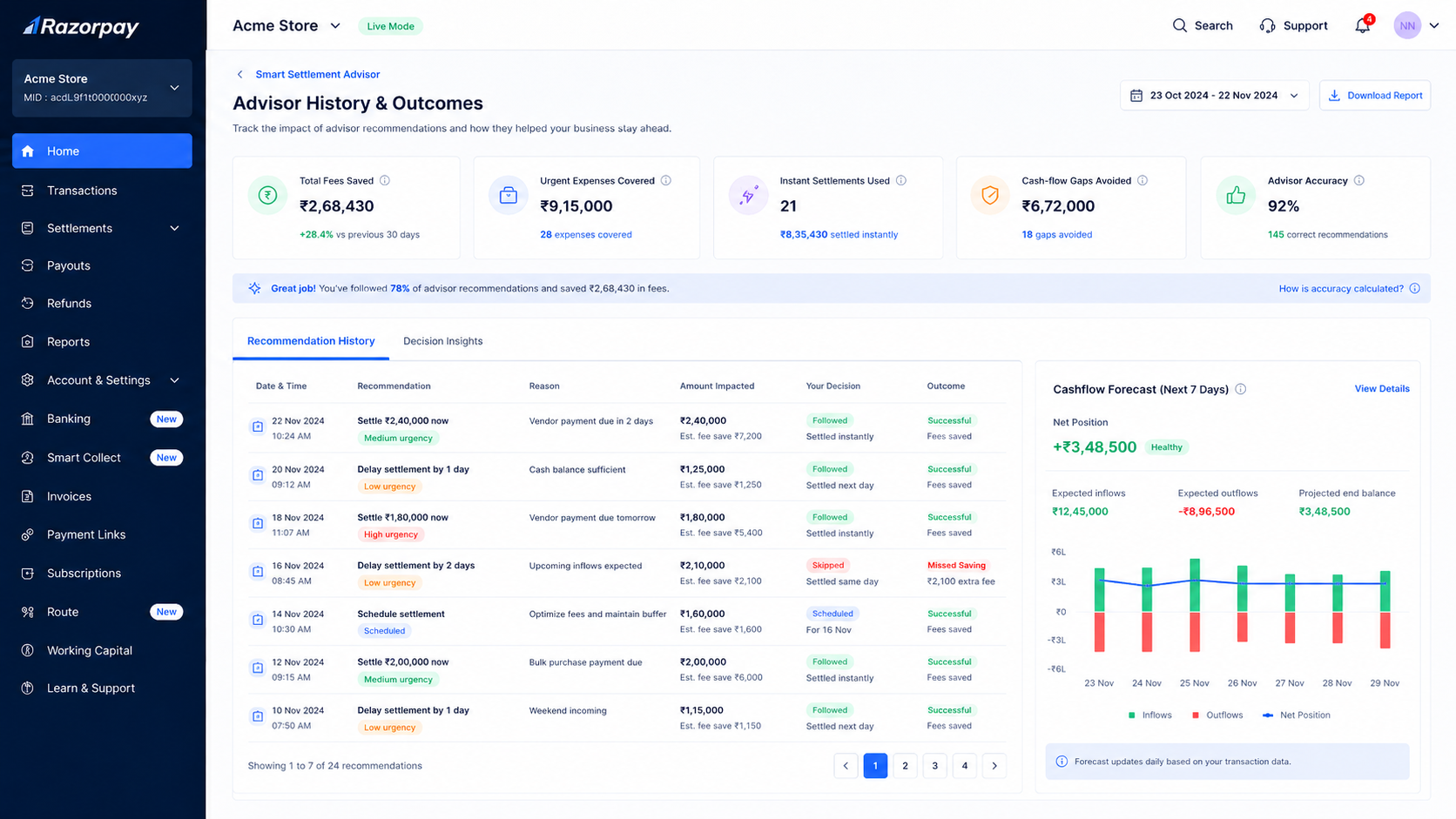
Learn from outcomes
Advisor history shows decisions, outcomes, and cash-flow impact over time.
The solution turns Razorpay from a settlement dashboard into a smarter merchant cash-flow decision partner.
01
Read liquidity
Understand available balance, incoming settlements, expenses, urgency, and current bank needs.
02
Surface tradeoff
Show the timing, fee, and operational risk behind each settlement option.
03
Recommend action
Suggest wait, instant settlement, or partial settlement while keeping the merchant in control.
Input layer
Cash-flow signals enter the system
Settlement balance, incoming funds, expenses, urgency, bank balance, and fee rules.
Detection layer
Cash gap is identified
The system detects if upcoming obligations may exceed available cash.
Recommendation layer
Settlement option is explained
Wait, settle now, or partially settle is recommended with fee and timing rationale.
Decision layer
Merchant stays in control
The user can accept, edit amount, compare scenarios, or defer action.
Outcome
Settlement becomes a decision
The product reduces liquidity stress and unnecessary settlement cost.
MVP Scope
The first version focuses tightly on the decision moment where users currently lose confidence.
Workflow shift
Move from manual setup and second-guessing to guided evaluation before the user commits to a product decision.
Product boundary
The MVP does not replace expert judgment. It adds a lightweight decision layer inside the existing Razorpay workflow.
MVP objective
Help merchants decide whether to wait, settle instantly, or partially settle by comparing balance, upcoming obligations, fee, and urgency.
In Scope
Purpose
Smart Settlement Advisor Entry
Appears in the settlement dashboard when balance and upcoming obligations create a decision moment.